|
|
Fighting Gum Disease: A Special Report Products discussed in this report: Essential Oils for Fighting Gum Disease The Hydro Floss Oral Irrigator The
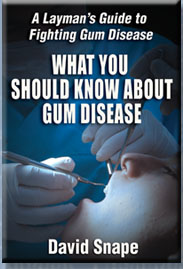
book: What You
Should Know About Gum Disease
I declined the treatment. That was a personal choice. I felt as thought I must find better answers. I did. I do not intend to imply that you should decline any treatment from your care provider. On the contrary, you should consider following your care provider's advice or get a second opinion and perhaps third opinion. The funny thing about dentistry is that you can go to three different dentists and will very often get three different answers about what needs to be done to your mouth. Periodontists are specialists that focus specifically on gum disease. I did my research and I found some things that helped a lot. I'm going to share a couple of them here in this report. First, let's talk briefly about what gum disease is. You have probably heard the term 'dental plaque' before. You have probably also heard the term 'calculus' or 'tartar'. These are all interrelated. Calculus and tartar are just terms for hardened, condensed plaque. Under plaque and tartar, bacteria are covered and isolated away from oxygen. This changes the way they digest food for energy. As result of this change, what they excrete is toxic to our dental enamel and gum tissue. These toxic waste products harm our tooth enamel and can lead to cavities. They also harm our gum tissue, or gingiva, and can lead to gum disease. Sometimes you hear the terms gingivitis (mild gum disease) or periodontal disease. These are all essentially caused by the same problem manifesting in various degrees. Namely, the anaerobic bacteria that release wastes and toxins that harm our tissues. Gum disease is the number one cause of tooth loss in adults. Consider for a minute just how many people suffer from gum disease. Periodontists (specialists in gum health and disease) tell us that approximately 80% of the adult American population have some form of gum disease. That equates to 8 out of 10 people. That means the chances are pretty high that you have it, your loved ones have it and about 80% of your friends have it. But the funny thing about this disease is, that almost no one believes they have it until the damage becomes pretty obvious. Lost tissue being the thing that the average person notices most. "Getting long in the tooth", is how some refer to it. Pretty scary thought, isn't it? Aside from losing teeth, gum disease can cause our gums to recede. With more recession comes tooth root exposure. The roots are a bit harder to keep clean and they can also become sensitive more easily than the rest of our teeth. If something that actually works isn't utilized, you will see the deterioration of gum tissue continue. Eventually, there is so little support for the teeth that they become loose and may fall. Even worse there is more and more research coming out that suggests that gum disease contributes to even larger health problems, such as stroke, heart attack and low birth weight and preterm babies. And it only makes sense that this long term chronic infection of the gums could feed a continuous supply of bacteria right into your blood stream. Gum disease in any form is serious and I hope you now understand that you must deal with it. You must stop it from getting worse and prevent it from coming back. The question now becomes, 'how do you do that'? If brushing and flossing were enough by themselves, there couldn't possibly be so many people with gum disease. That's easy enough for anyone to see. My book, What You Should Know about Gum Disease covers the answer in relative detail. In this report, I'm going to give you a couple of things that can help hold you over until you can get your hands on the book. Though these items can help. I think you really will need the information contained in the book both to understand the problem more completely and to provide you with information that may allow you to solve your own gum disease problem more fully and hopefully, permanently. No guarantees are made, however, as everyone is different and will try to varying degrees and there may be other factors involved as well. I do firmly believe that the majority of people CAN stop the progression of gum disease and prevent it from coming back or prevent it from developing in the first place. I also believe that most dentists can't or won't tell you how to do that - unfortunately! If they are stuck on the notion that brushing and flossing are all that you need, I have to respectfully disagree for the reasons mentioned above. Simply brushing and flossing may be enough for a small minority of people, but I don't believe it is enough for most of us. Some people don't go to the dentist. I'm telling you that you should go and never stop going again. The consequences to your teeth, gums and overall health could be larger than not going. At the same time, you may need to ask your dentist to approve a home care routine that is outside what she normally recommends to her patients. I personally found that my dentist didn't help me much with the care of my gums. She was good at sagely nodding her head as she examined my mouth. But she failed to impress upon me that the bleeding I had during dental probing and professional cleanings for several years at her office was a serious problem that needed to be dealt with. This was extremely unfortunate and I could have saved a lot of gum tissue that was lost as a result. I do not want you to suffer a similar fate. When I finally realized that this bleeding was an indication of a problem, I had already lost gum tissue that I would like to have kept. Eventually, she told me I needed the SRP treatment, but unfortunately, damage was already done. Had she said something sooner, maybe things would have been different. There is a popular mouthwash on the market that contains a lot of alcohol. It is a mouthwash that is approved by the ADA (American Dental Association) to kill germs. Many people think it is the large amount of alcohol that kills germs. But what they don't realize is that among the active ingredients are two essential oil derivatives. Those are eucalyptol and menthol. Now the alcohol may contribute for sure. But there is a reason eucalyptol and menthol are in the active ingredients. So, the first product I'm going to suggest and that I have personally used, even though I don't currently use it, is an essential oil blend of spearmint, peppermint and almonds. You can read more here . At the time of this writing, the company is offering a buy 2 and get 1 free offer to 1st time customers. When I first purchased it, the lady on the phone told me that it cleared up her bleeding gums in just two weeks. They have a large volume of testimonials that you can read on their site. Now, I have to say that this product did NOT clear up my bleeding gums. But I'm still telling you about this product because every body is different and may respond differently to different things. Be sure to get your dentist's approval before trying any products that you find in this report or anywhere else. And remember, if you don't like the advice that one dentist gives, you have the absolute right to seek a second or even third opinion. The device that did help my gums to stop bleeding was the Hydro Floss. The Hydro Floss comes with an instructional video on how to use it and care for it. Using the Hydro Floss produced fantastic results for me. My dentist and hygienist were visibly amazed when they told me there was no more tartar under my gums and that I did not need their SRP treatment after all. What seems rather strange to me is that my dentist did not know about this device or what it could do. Shouldn't my dentist have informed me about this tool? The Hydro Floss and what it can do as been written about, twice, in the Journal of Clinical Periodontology. Some dentists sell it from their offices. Yet, when I asked her about it, she actually told me not to get one, and to buy a regular irrigation device. The studies I just mention show how the Hydro Floss is more effective than other irrigators and preventing the build up of plaque and calculus. Yet, she told me to get another type of irrigator because it was a little less expensive. If you use the link above you will also get a free bottle of AktivOxigen compound with your purchase. If you remember, I said that the bad bacteria were secreting their poisons because they were using a non oxygen process for fueling their growth. Introducing oxygen into their environment can either cause them to switch back to using oxygen or will kill them. Either case is a win for you. Plaque isn't something you just get rid of once and then it goes away. No, it doesn't work that way. You have to continually disrupt the plaque to prevent the bacteria from switching to their non oxygen way of making energy -because that is when they start to secrete those toxins we don't want. Plaque must be disrupted at least daily and to be safe, perhaps even more frequently. After all, these are your teeth and gums we are talking about. And I'm pretty sure you would like to keep them as well as avoiding the cost and hassles of dentures or implants Get What You Should Know About Gum Disease Plaque can be disrupted by brushing and flossing, but I fear that brushing and flossing isn't enough for most people. If they were, you wouldn't have up to 80% of the population suffering with gum disease. In addition, can you be sure that you are getting everything, routinely? Brushing and flossing should not be abandoned however, they are still very important to do at least part of the job. I believe that adding the Hydro Floss helped me to get rid of excessive bacteria around and possibly even under my gumline. You can watch the video that comes with the Hydro Floss for more details. It stopped my gums from bleeding and saved me from a couple of costly and potentially painful treatments that the dentist wanted to perform on me. This is the highest praise I can give the Hydro Floss: It worked for me! As powerful as these tools may be, they may not provide a complete solution to the problem. There is much more to learn on this topic, and I believe you will find What You Should Know about Gum Disease to be of even greater help than this short report. Products discussed in this report: Essential Oils for Fighting Gum Disease The Hydro Floss Oral Irrigator The book: What You Should Know About Gum Disease
Wishing you the best possible dental and overall health! Warm Regards, David Snape PS: You can ask questions at http://tobeinformed.com/ask-dave-a-question PPS: Though not directly related to fighting gum disease, I would like to inform you of the energizing, easy and relaxing exercises of Falun Dafa. I value these exercises highly and consider them the cornerstone of my overall health regimen. You can view the video instruction of these great exercises online at no cost. You may watch the exercise videos in English here: http://www.falundafa.org/eng/exercises.htm Basic instructions are also available in many other languages at the same site.
Click Here to Learn
More about This | ||
|

 Delicious
 Digg
Digg Technorati
 Yahoo My Web
 Facebook
 Google Bookmarks